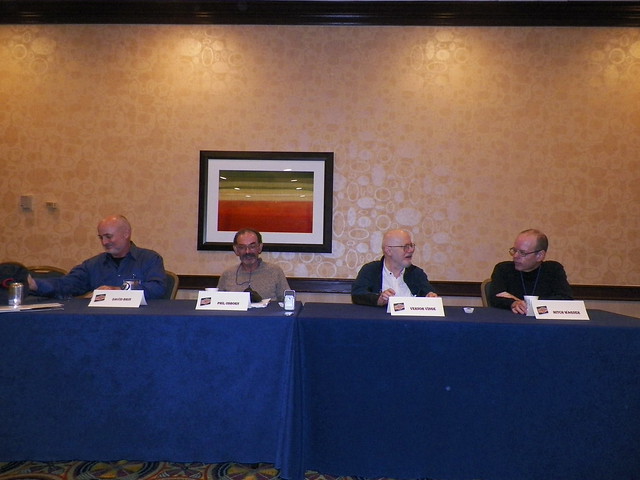
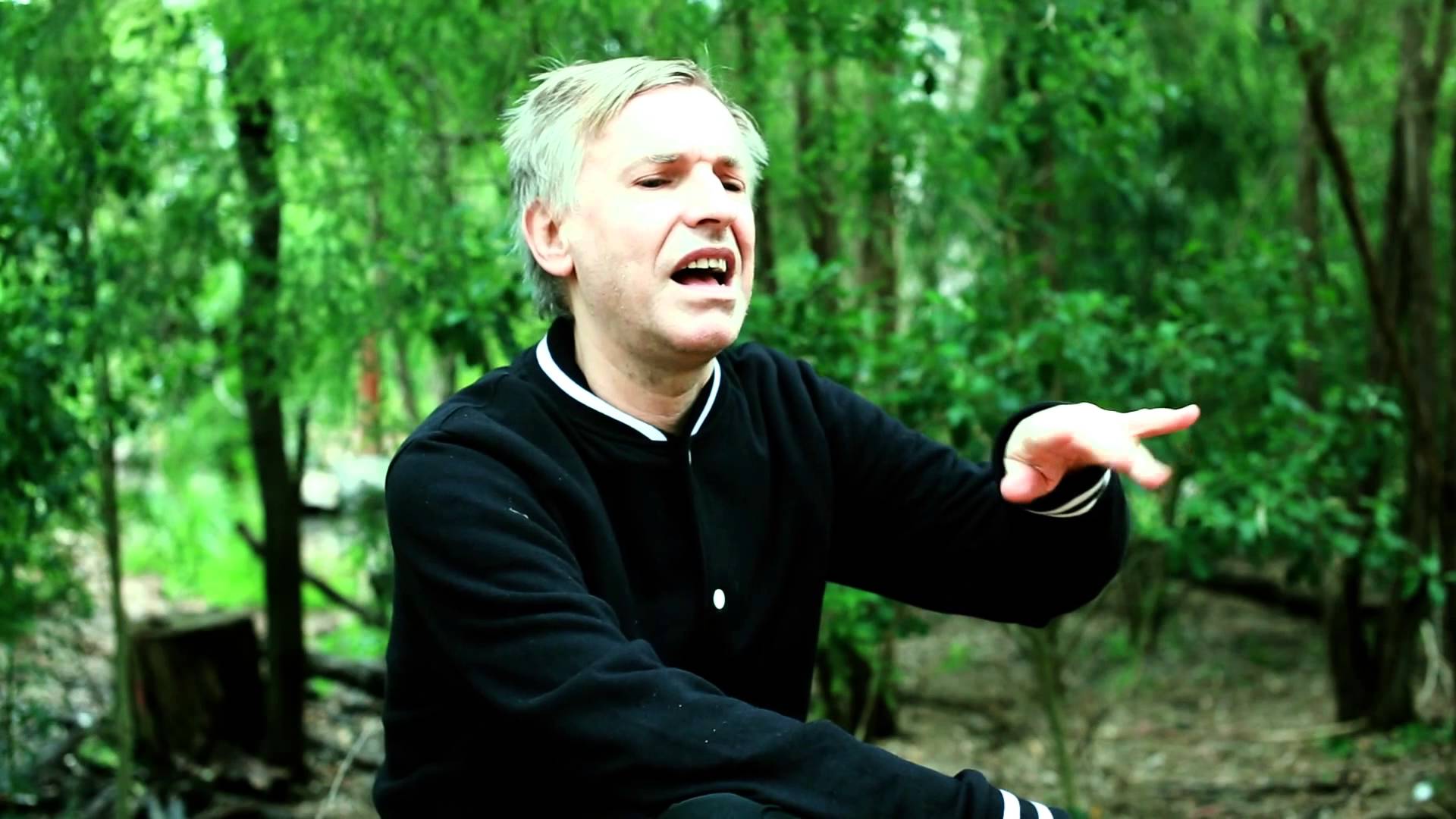
Panelists: David Brin, Phil Osborn, Vernor Vinge, Mitch Wagner. Filmed at Los Con 39 #loscon
On November 24, 2012 at LAX Marriott Hotel, Los Angeles, California.
aleph.se/Trans/Global/SingularityThe technological singularity is a hypothetical event related to the advent of artificial general intelligence (also known as “strong AI”). Such a computer, computer network, or robot would theoretically be capable of recursive self-improvement (redesigning itself), or of designing and building computers or robots better than itself. Repetitions of this cycle would likely result in a runaway effect – an intelligence explosion – where smart machines design successive generations of increasingly powerful machines, creating intelligence far exceeding human intellectual capacity and control. Because the capabilities of such a superintelligence may be impossible for a human to comprehend, the technological singularity is the point beyond which events may become unpredictable or even unfathomable to human intelligence.
The term technological singularity was popularized by mathematician, computer scientist and science fiction author Vernor Vinge, who argues that artificial intelligence, human biological enhancement, or brain–computer interfaces could be possible causes of the singularity.
Guest of Honor: Vernor Vinge
Artist Guest of Honor: Alan White
Fan Guests of Honor: Lloyd Penney & Yvonne Penney
Costume Guest of Art: Mela Hoyt-Heydon
Part 1 in an interview with Eric Sampson on Moral Realism. Note AI is referenced, but the bulk of the questions about AI are covered in part 2. Chapters 0:00 Intro 3:03 Why is moral realism attractive to AI Safety Research? 2:02 Background, & Personal reason to choose moral realism 4:00 Describing moral realism –…
In a blinded Moral Turing Test, people rated GPT-4’s moral answers higher than humans’ across most measures – yet they could still tell it was AI. Are we priming the public to over-trust machine morality? Interview with Dr Eyal Aharoni, Ph.D. – Associate Professor of Psychology, Philosophy, and Neuroscience Georgia State University Attributions toward artificial…
Hard realist alignment: align advanced AI to stance-independent moral facts rather than human preference aggregates. Preference-realism hybrid: align to human preferences, regularised by stance-independent moral facts.Mechanism: indirect normativity with explicit procedures for discovery, uncertainty handling, and safety interlocks. The principles behind the development of powerful AI carry exceptionally high stakes. This post considers AI alignment,…
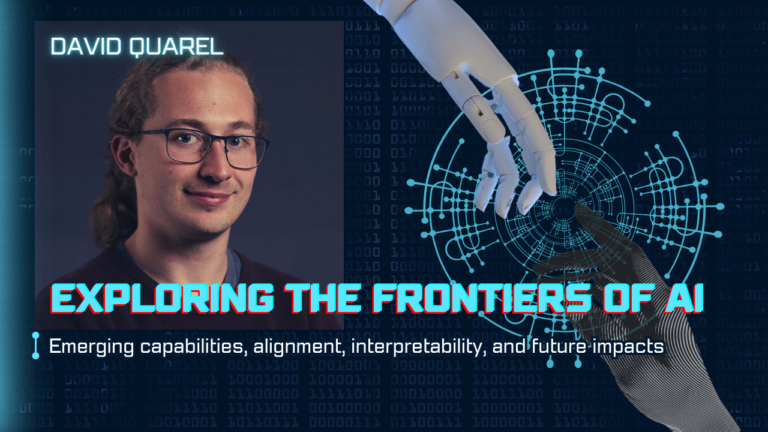
David Quarel, a Ph.D. student at the Australian National University, is deeply involved in the field of AI, specifically focusing on AI safety and reinforcement learning. He works under the guidance of Marcus Hutter and is currently engaged in studying Hutter’s Universal AI model. This model is an ambitious attempt to define intelligence through the…
It is non-trivial for a couple of reasons:a) the pursuit of this vision of happiness is not trivial – it is likely to be a very challenging endeavor (though totally worthy of the effort)b) the aim is to achieve non-trivial modes of happiness, kinds of information-sensitive gradients of bliss (as opposed to being stuck in…
Note: this is by no means exhaustive. it’s focus is on western philosophy. I’ll expand and categorise more later… The earliest precursors to indirect normativity can be traced back to early philosophical discussions on how to ground moral decision-making in processes or frameworks rather than specific, static directives. While Nick Bostrom’s work on indirect normativity…