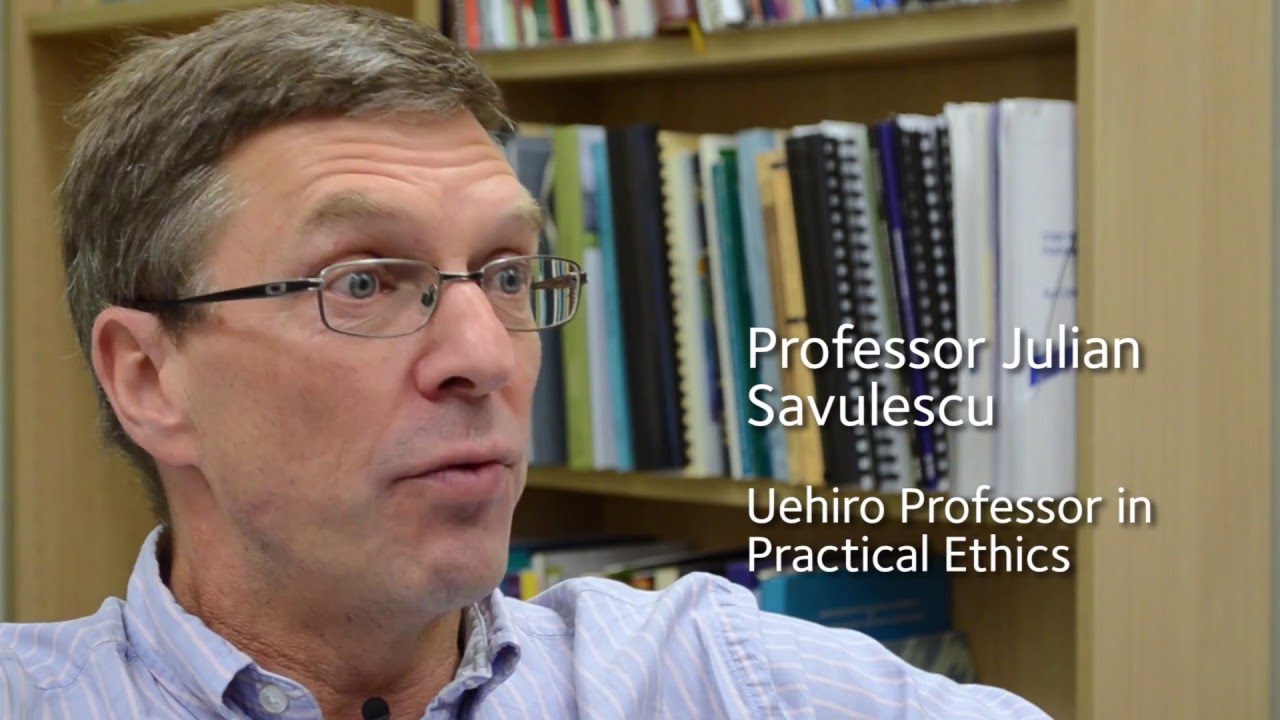
Julian Savulescu – Partiality to Humanity and Enhancement
In this presentation, ethicist Julian Savulescu explores whether bioconservative objections to human enhancement can be rooted in “partiality for humanity”—the idea that we have a moral reason to prefer or protect human nature simply because it is our nature [02:29].
Collaborating with Guy Kahane and Jonathan Pugh, Savulescu analyzes and critiques the late-life arguments of philosophers Bernard Williams and G.A. (Jerry) Cohen to see if a viable middle ground can be found between liberals and conservatives on the enhancement debate [00:12].
1. The Core Arguments of Williams and Cohen
Savulescu focuses on two thinkers who developed quite conservative stances on human enhancement towards the end of their lives:
- Bernard Williams and “The Human Prejudice”: Williams argued that being a member of the species Homo sapiens operates as a foundational moral reason to privilege humans in our moral deliberations [04:11, 05:56]. He famously noted that if a building is burning, we don’t need to know anything more than “human beings are trapped inside” to deploy resources to save them [06:44]. For Williams, wanting to radically alter human flaws risks crossing into a form of self-hatred—specifically, a hatred of humanity [13:07].
- G.A. Cohen and “Conservative Valuing”: Cohen defended a bias toward retaining existing things of value, even if they could be replaced by something of greater value [07:18]. He divided this into two modes:
- Particular Valuing: Valuing an existing object for itself (e.g., refusing to destroy the Pyramids of Giza just to build a “better” pyramid on the same site) [08:07].
- Personal Valuing: Valuing an object because of our unique relationship or shared history with it (e.g., keeping a creaky family dining table or a wedding dress) [09:24, 10:17]. Cohen applied this to humanity, arguing we have an additional reason to preserve humans as they are because “they are us” [11:20].
2. Savulescu’s Critiques and Reconstruction
While Savulescu finds these frameworks fascinating, he points out significant limitations in their original forms:
- The Status Quo & Discrimination Trap: Cohen’s view can easily look like simple “status quo bias” [16:11]. Meanwhile, Williams fails to prove that a foundational “human prejudice” is morally distinct from deplorable prejudices like racism or sexism [16:29].
- The Burning Building Test: Savulescu modifies Williams’s example: if the burning building contained permanently unconscious humans versus a highly sentient, benevolent alien person, common sense dictates we should save the alien [21:49, 22:20]. This proves that personhood (intrinsic moral status), not biological humanity, does the heavy lifting [22:04].
The Reconstructed View: Savulescu argues that partiality for humanity is only justifiable if it is grounded in a shared biological and cultural history that has allowed us to develop the valuable capabilities of personhood together [24:58, 25:11]. This partiality could allow you to permissibly choose to save a human person over an equally or more sentient alien person if all else is equal [23:06].
3. Implications for Human Enhancement
Even if we accept this revised partiality for humanity, Savulescu concludes it only places very weak, defeasible (overridable) limits on enhancement [03:23]:
- Lexical Inferiority: Moral reasons generated by “moral status” (protecting the lives and flourishing of persons) always trump reasons of partiality [27:27]. For example, if cognitive or moral enhancements are required to keep humanity from destroying itself with advanced technology, partiality cannot rule them out [27:42].
- Improvement vs. Replacement: Enhancements like life-extension or preventing normal age-related cognitive and physical decline do not destroy humanity [15:07, 28:19]. They preserve and protect our existing valuable capacities, much like restoring the aging stonework on an old building [28:35].
Q&A Insights
During the audience questions, the discussion digs into the difficulty of drawing species lines. Savulescu acknowledges that defining “humanity” purely by 46 chromosomes is weak [38:26]. He argues that instead of focusing on biological categories, the focus should shift to personhood [37:20]. We are bound to one another by reciprocal, cooperative, and deeply dependent relationships that give our lives meaning—and it is this web of personal relationships that gives us a reason to resist radical transhuman/posthuman changes that might fracture that bond [32:57, 33:58].