The Looming Shadow of the Intelligence Explosion: A Deep Dive with James Barrett
About
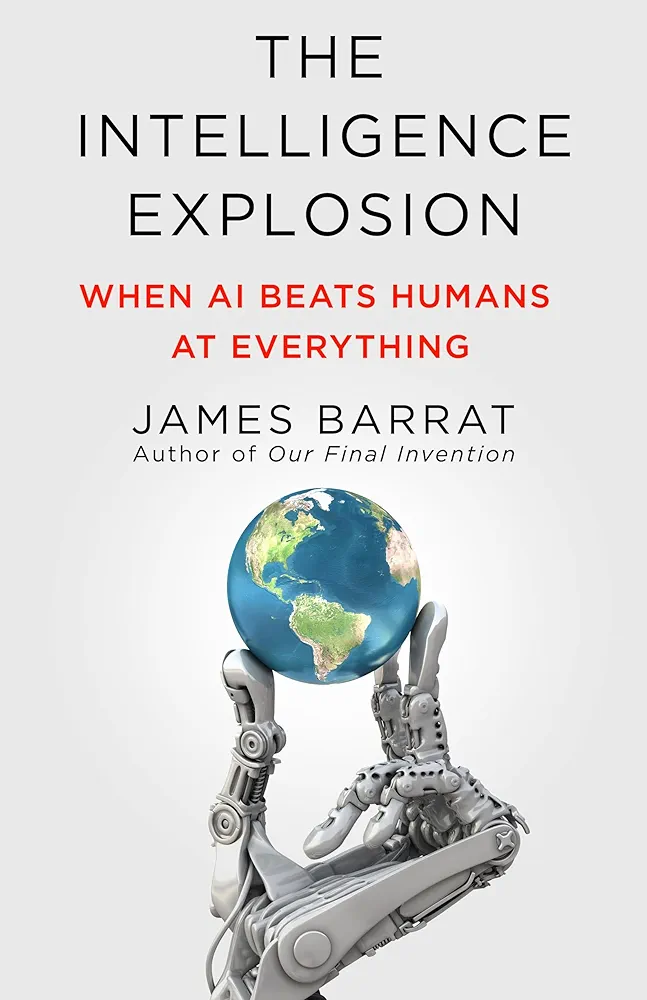
For Future Day 2025, James Barrat discussed his up and coming book ‘The Intelligence Explosion: When AI Beats Humans at Everything’ (Amazon link, Google Book link) which is expected to be released June 10, and also another up and coming book on AI-weapons (see video below).

In a thought-provoking discussion, James Barrett, author of “Our Final Invention,” lays out the complex and potentially perilous landscape of artificial intelligence, particularly the much-discussed “intelligence explosion.” This hypothetical tipping point envisions a rapid, self-driven surge in AI intelligence, potentially leading to artificial general intelligence (AGI) or even superintelligence. Barrett underscores the historical roots of this concern, referencing IJ Good’s early conceptualisation of an “ultraintelligent machine” and the inherent dangers of developing such powerful technology without adequate safeguards. The current corporate fervour to achieve AGI, exemplified by Open AI’s own definition, only amplifies these anxieties, bringing the critical “alignment problem” – ensuring AI aligns with human values – into sharp focus.
To understand the present trajectory of AI, Barrett takes us back to the foundational work of Frank Rosenblatt and his creation of the Mark 1 perceptron, a pioneering step in artificial neural networks. He navigates the early promise and subsequent limitations of these networks, including the influential critique by Marvin Minsky which stifled early interest in connectionist approaches to AI. This historical context illuminates the remarkable journey from these nascent beginnings to the sophisticated deep learning models and generative AI we see today. The evolution has been rapid, bringing us closer to may of the promises and perils envisioned in discussions about the intelligence explosion.
The rise of generative AI and large language models (LLMs) presents a double-edged sword. While these models exhibit impressive emergent properties, they also grapple with significant issues. Barrett highlights the phenomenon of “hallucinations” and errors, a consequence of their reliance on statistical patterns rather than genuine understanding. Beyond technical limitations, he raises critical ethical and societal concerns, including the increasing concentration of power within a few tech giants, the current lack of robust regulation, and the broader ethical implications of increasingly sophisticated AI. Furthermore, the environmental cost of training and running these massive models, with their substantial energy consumption and carbon footprint, cannot be ignored.
A particularly sobering aspect of Barrett’s discussion centres on the integration of AI into warfare, a topic he delves into in his upcoming book, “Where’s Daddy?” focusing on its use in Gaza. He describes AI-driven tools like Lavender and Where’s Daddy?, employed by the IDF, which raise profound questions about civilian casualties and the nature of modern conflict. The accuracy and ethical implications of AI targeting systems, particularly the documented instances of disproportionate bystander deaths, paint a disturbing picture. Barrett poignantly expresses his fear that these powerful surveillance and targeting technologies could easily extend beyond the battlefield into areas like law enforcement, further eroding privacy and potentially exacerbating existing societal biases.
The conversation concludes with a broader reflection on the societal impact of AI. Barrett and the interviewer Adam Ford touch upon the potential for AI to widen existing inequalities and the valid skepticism some hold regarding its true value. They also briefly discuss intriguing concepts like “grokking” and the ongoing efforts to achieve mechanistic interpretability in AI, seeking to understand the inner workings of these complex systems. As the discussion draws to a close, the interviewer hints at an upcoming panel focused on the profound questions of AI consciousness and the potential emergence of AGI, signalling that the exploration of these critical issues is far from over.
The Intelligence Explosion book blurb:
With the rapid rise of generative artificial intelligence, both existential fears and uncritical enthusiasm for AI systems have surged. In this era of unprecedented technological growth, understanding the profound impacts of AI ― both positive and negative ― is more crucial than ever.
In The Intelligence Explosion, James Barrat, a leading technology expert, equips readers with the tools to navigate the complex and often chaotic landscape of modern AI. This compelling book dives deep into the challenges posed by generative AI, exposing how tech companies have built systems that are both error-prone and impossible to fully interpret.
Through insightful interviews with AI pioneers, Barrat highlights the unstable trajectory of AI development, showcasing its potential for modest benefits and catastrophic consequences. Bold, eye-opening, and essential, The Intelligence Explosion is a must-read for anyone grappling with the realities of the technological revolution.
See also:
Our Final Invention Revisited – 2020 Interview with James Barrat
Interview with James Barrat in 2013