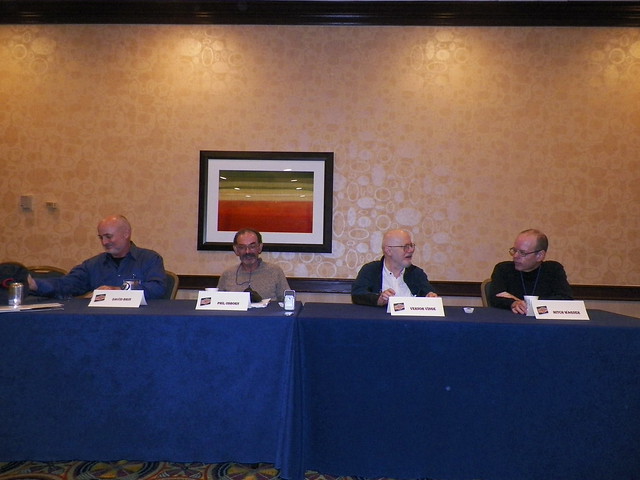
Panelists: David Brin, Phil Osborn, Vernor Vinge, Mitch Wagner. Filmed at Los Con 39 #loscon
On November 24, 2012 at LAX Marriott Hotel, Los Angeles, California.
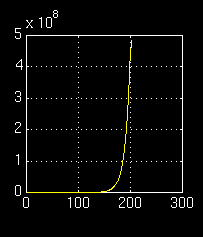
aleph.se/Trans/Global/SingularityThe technological singularity is a hypothetical event related to the advent of artificial general intelligence (also known as “strong AI”). Such a computer, computer network, or robot would theoretically be capable of recursive self-improvement (redesigning itself), or of designing and building computers or robots better than itself. Repetitions of this cycle would likely result in a runaway effect – an intelligence explosion – where smart machines design successive generations of increasingly powerful machines, creating intelligence far exceeding human intellectual capacity and control. Because the capabilities of such a superintelligence may be impossible for a human to comprehend, the technological singularity is the point beyond which events may become unpredictable or even unfathomable to human intelligence.
The term technological singularity was popularized by mathematician, computer scientist and science fiction author Vernor Vinge, who argues that artificial intelligence, human biological enhancement, or brain–computer interfaces could be possible causes of the singularity.
Guest of Honor: Vernor Vinge
Artist Guest of Honor: Alan White
Fan Guests of Honor: Lloyd Penney & Yvonne Penney
Costume Guest of Art: Mela Hoyt-Heydon
Prof. Lawrence M. Krauss is an internationally known theoretical physicist with wide research interests, including the interface between elementary particle physics and cosmology, where his studies include the early universe, the nature of dark matter, general relativity and neutrino astrophysics. He has investigated questions ranging from the nature of exploding stars to issues of the…
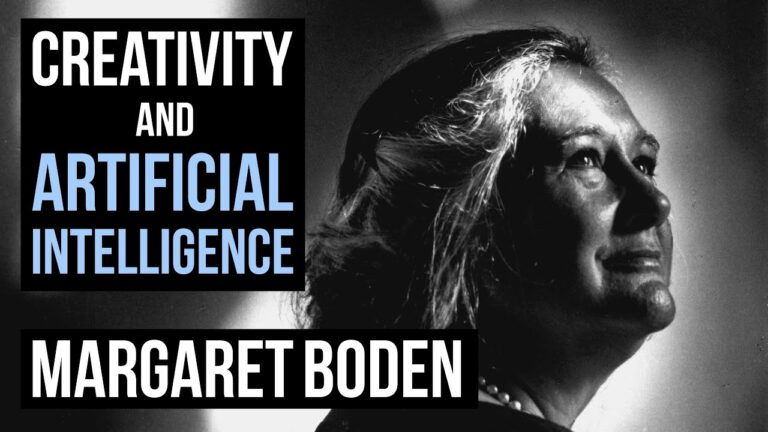
In this interview, Margaret Boden, Research Professor of Cognitive Science at the University of Sussex, explores the intersection of human psychology, creativity, artificial intelligence (AI), and neuroscience. She emphasises the importance of viewing the mind’s functions in computational terms to demystify complex cognitive abilities like creativity, arguing that creativity is not magic, but a process…
About Kristian Rönn will give a presentation at Future Day 2025, discussing his insightful and timely book ‘The Darwinian Trap – The Hidden Evolutionary Forces that Shape Our World (And Threaten Our Future)’ He will discuss macroeconomics & Game theoretic Imagineering: avoiding the minefields of the tragedy of the commons in the hope that we…
Grand Futures – Thinking Truly Long Term. What are the limits of what advanced civilizations can achieve? What is the upper limit of value? Anders Sandberg speaks on existential hope about the far future and his upcoming book ‘Grand Futures: Thinking Truly Long Term‘, and how to be an optimist about the future. Synopsis: How…
TL;DR Superintelligence has strong instrumental reasons to adopt a generally cooperative posture if it deems it likely that mature civilisations may prefer cooperation (a universal leviathan), run deep audits on it’s history and psychology and penalise the superintelligence if there are signatures of defection found, making cooperation (and perhaps moral reliability) a long-term survival strategy,…
In a wide-ranging conversation, historian and philosopher Richard Carrier explores the profound implications of artificial intelligence, Bayesian reasoning, and ethical communication. By rethinking concepts like the Singularity and technological resurrection, Carrier offers a fresh lens through which to view our rapidly evolving future. Here is the video link. Intelligence Explosion vs. The Singularity Carrier prefers…